In the previous post, we talked about how to set your business and voice. All of the behind the scenes tasks that add up to your message.
This is part 4 in a 4 part series:
**Part #1: $1.5K In Sales Selling 3D Bronze Maps - Idea Generation + Validation
****Part #2: Making My Way Through Manufacturing: 3D Printing + Bronze Casting
****Part #3: Behind The Scenes: Brand Identity (Logo, Photography) & Admin Tasks (Tools Used, Automation)
**Part #4: Sales: Trying To Sell A Physical Product From Scratch
Who am I? My name is Greg Kamradt and I am the founder of Terra Mano, we make handcrafted maps of American landscapes. Think 3D printed mountains cast in bronze geared towards outdoor athletes and mountainous vacation goers.
One of the reasons I picked up this project was to try something I knew nothing about. A few people have asked about this process so I wanted to write it out for others. This post is what I would have liked to read at the beginning of the journey.
-
This post we are going to look at the Sales parts of Terra Mano. How do you get people to buy your product? Or get retailers to stock your collection?
We’ve sold 6 units for a total of $1,500: 5 @ $250, 2 @ $125 (Retail). A couple more and I’ll hit profitability.
What we will cover:
Online Sales + Media Outreach
Retail Sales
Search Engine Optimization (SEO) & Paid Ads
TL;DR: Retail shops will take 50% of your margin. The key to online sales is traffic to your site. It’s much harder than it sounds. Small products start with one on one sales.
Online Sales
Here is the quick rule of thumb I’ve seen for selling physical products:
$1 - Your cost to make the product
$2 - What you sell the product to a retail shop at
$4-$4.40 - What both you and the retail shop should sell the product for. This means retail shops take +50% of your margin.
Shopify Store
I use Shopify to run my online store. It costs me $29/month. It’s great for order and customer management. The free themes are not bad, not great. I currently run Brooklyn.
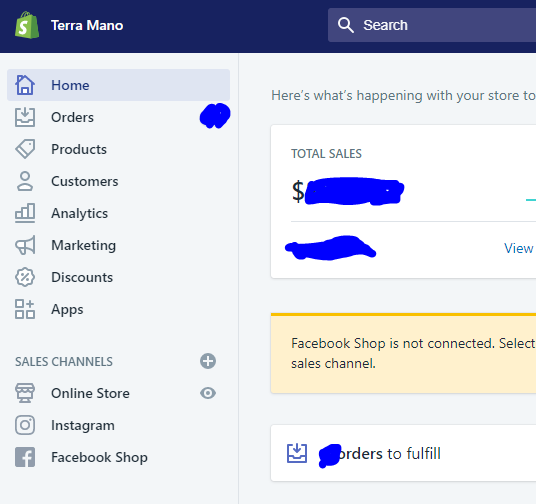
I wish it had the flexibility of a Wix, Squarespace, or Wordpress. You can drag and drop some items, but anything above elementary adjustments you’ll need to open up the code and do it yourself.
It’s fine for now while I’m staying cheap. If I ever decide to upgrade I’ll go with another theme and get a developer off Upwork to make edits.
Outreach, Or My Launch Day Plan
TL;DR I emailed a list of 100 online retails/publications, IG messaged 30 editors and ended up getting 1 feature by GearJunkie.
My store never had an official “launch date.” I didn’t have enough of a social following, nor was I going to do paid advertising to justify one.
Regardless, I did a “launch” once I had my product photography and was ready to show publishers my site.
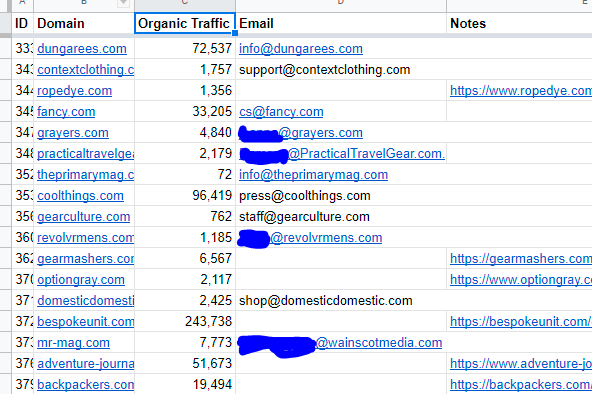
To find people that could write about Terra Mano I used a great tool called SEMRush. It has a couple amazing features, one of which being a “similar domain generator”. Not only was I able to see even more market players in the 3D map space, I was able to quickly source a large number of online publications.
Using Huckberry as a search term, SEMRush was able to spit out a list of their 5,000 similar sites. This included other retail shops, but it also included websites who linked to Huckberry products.
This was a goldmine, because if these websites linked to Huckberry products, maybe they would link to other mountain focused products aka Terra Mano products.
Using this list I gathered as many email addresses of editors, writers, and founders as I could. I also checked out some people who worked for these companies to see if they were open to conversations on Instagram and Twitter.
Note: My personal rule of morals: If the person advertised their workplace on their social handle then it was ok for me to message them. If they didn’t, I didn’t bother them with work things.
Come launch day, I messaged ~100 people/companies and about 10 responded favorably. Of those, only 1 ended up writing a feature, GearJunkie - Forged by Fire: Bronze Maps Bring Mountains to Life.
Most of my responses to influencers or writers in the area went like this:
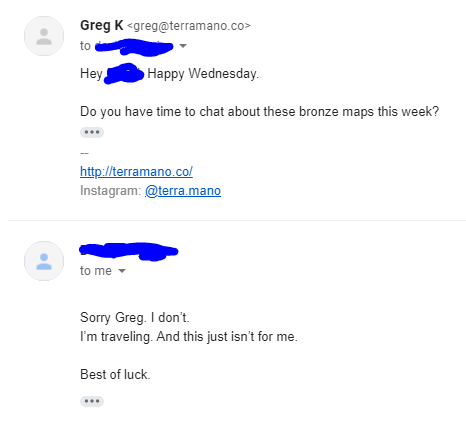
Oh well, it’s not for everyone.
Retail Shops
The second sales channel were retail shops. I wasn’t too excited about this route because of the margins (see above, they take 50%), but I was in an “exhaust every option” kind of mood.
I web-scraped a list of 100 Tahoe retail shops from Tahoe.com and exported them to a spreadsheet. After that I went through all 100 and gave them a quick ranking, 1, 2, 3, to prioritize.
I made a Google Map with my top 50 shops to go and visit.
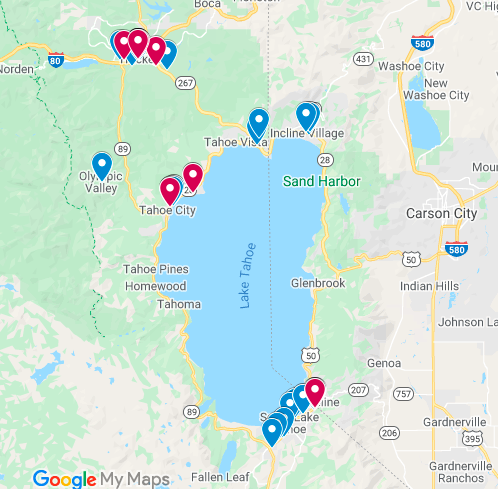
Then I took 3 days off and drove up to Tahoe to see what I could do. I called it a Product Road Show
My plan was to walk into each shop, show off the product, get a hold of a manager or buyer, and then follow up with more information.
Of the 50 shops I walked into:
30 weren’t a good fit. This was either because their product line was too low priced or they didn’t think it was a good match
10 said that the product was too expensive for their customer base
5 didn’t like the “Lake-ness” of the piece. They wanted more generic mountain items
4 were interested and eager to hear more information
1 bought on the spot
I counted this as 5 out of 50 were successful, or 10%. My friends tell me that 10% in sales is a good sign, but I don’t believe them.
Lessons learned from walking into 50 shops
I could have filtered out a ton of shops by asking what their product price range was before hand
The conversation will always go to email, so start there first instead of walking in
Going during the middle of the week during the off-season is a solid idea. No one is in the shop and you can get more attention.
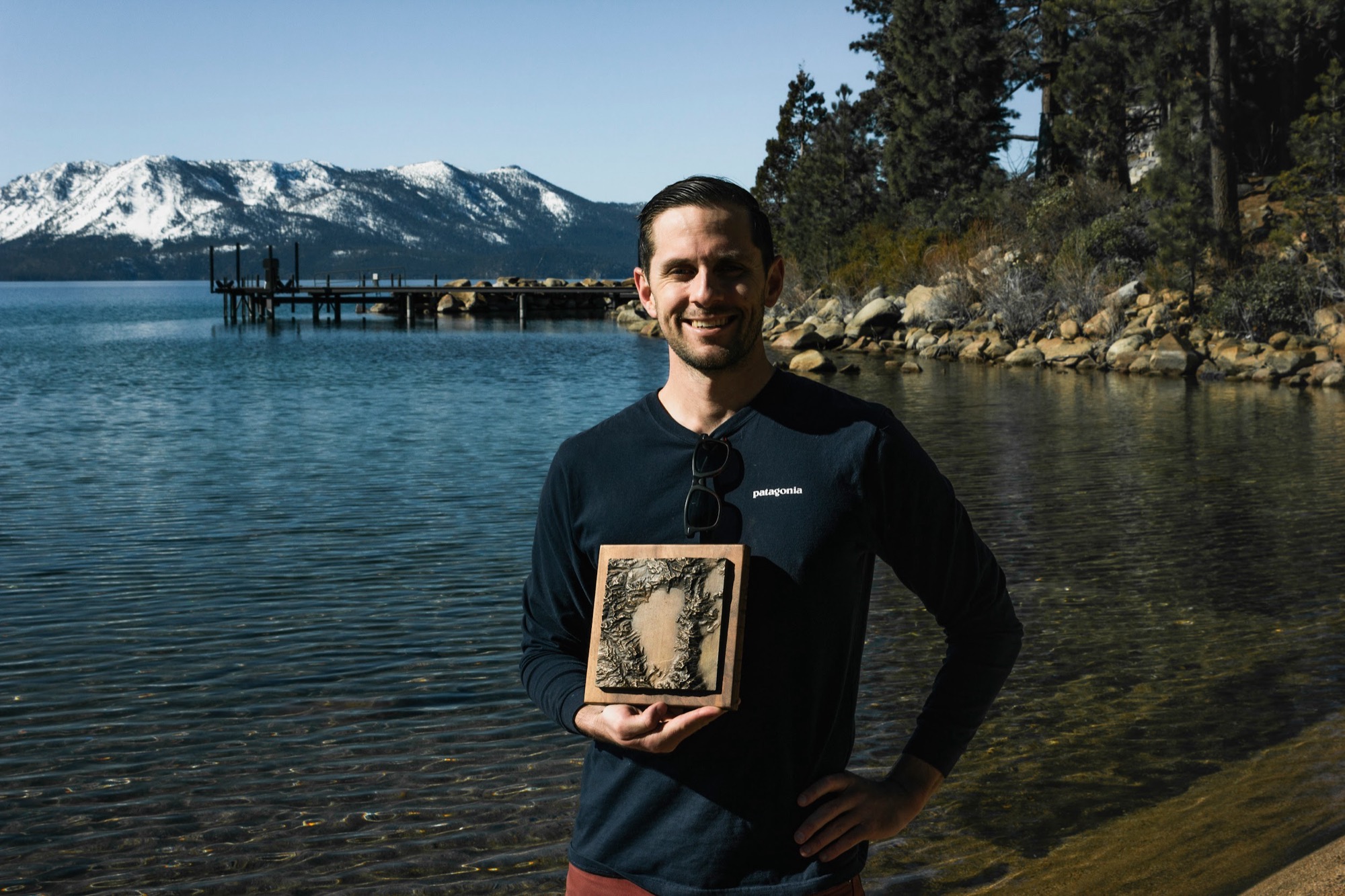
Here’s a picture of me Mid-Tahoe Road Show:
Search Engine Optimization (SEO)
TL;DR: SEO takes a lot of time/energy and months to pay off. I’m still waiting for the fruits of this labor.
SEO is the process of optimizing your website to appear higher in search results pages so more people come to your website. This is why recipes these days have 2K words of gibberish before the thing you actually need, the recipe. Ex: 1K words on this recipe before the good stuff.
I worked on SEO in three ways: 1) Content Marketing - Stories Of The Mountain 2) Blog Posts 3) Product Pages
Stories Of The Mountain is a collection of interviews of outdoor athletes. It’s a great way to get your platform promoted and promote other people at the same time. Read more about it on my previous post.
I wrote 3D Maps: The Ultimate Guide as a way to try and attract people searching for 3D maps and likely to buy products. So far only 142 people have seen the page. I’ve heard SEO takes a while kick in and this one has been marinating for 3 months. We’ll see if it grows.
Finally product pages, it’s important to put good words in your product descriptions. Not only will this help people understand your product, but it’ll also help Google show your product to the people who are searching for it.
If you want more information about SEO, head over to Hubspot and read up.
Paid Advertising
I’ll keep this short and sweet. Paid ads haven't worked for me yet.
Rarely will I blow money on something that isn’t awesome, but I’ve given Facebook and Google $100s and they haven’t given much back.
Facebook ads - You’ll get traffic to your site, and a few likes, but not much
Google ads - You’ll get traffic to your site
Instagram ads - You’ll get likes on your post
Also, I paid @cabinaddicted $20 for a post to see what would happen. In the end I estimate I got 156 likes, 3 follows, 1-2 website visits, and 0 products bought.
I’ve learned that people don’t buy a $250 product by clicking on an ad from Facebook or Google and then give you their credit card. They buy a product like that through building a relationship with a brand.
Relationships with brands only happen over time. There’s no rushing it. Especially when you’re starting off as a side project.
Finishing Up Sales
Besides your own happiness, sales is the most important part when evaluating a side business. If you can’t sell your product, then it doesn’t matter how much brand or manufacturing knowledge you have.
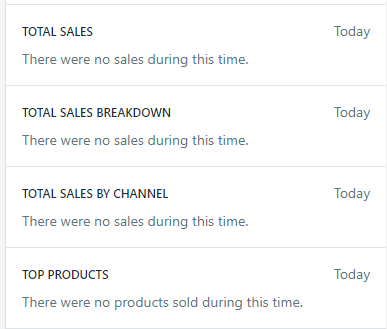
My highest leverage sales activity has been focusing on one customer at a time through one-on-one conversation and outreach.
Wrapping Up The Series
If you’re interested in starting up your own physical product I hope this guide helps shed light on what’s ahead.
I’m always happy to speak with those in the same position and knowledge share.
Here are some quick lessons learned I’ll leave with you
You can do your business viability math before you ever start trying to make a product. Make sure you’re happy with that math.
Set your expectations and then lower them. Trying to start up a business from scratch is very tough and there is little reward in the early days.
That being said, starting a business takes a bit of “blind faith” that what you’re working on will succeed. Your friends and family may not get it, but most ideas look crazy when they start.
If possible, don’t go to market with just one product, try for at least two. I wish I had another location ready to go besides Lake Tahoe. We are working on Mt. Rainier right now.
Thank you for reading!
If you have questions about Terra Mano or any details in these posts. Don’t hesitate to reach out.